Why Do Funny Pet Portraits Work?
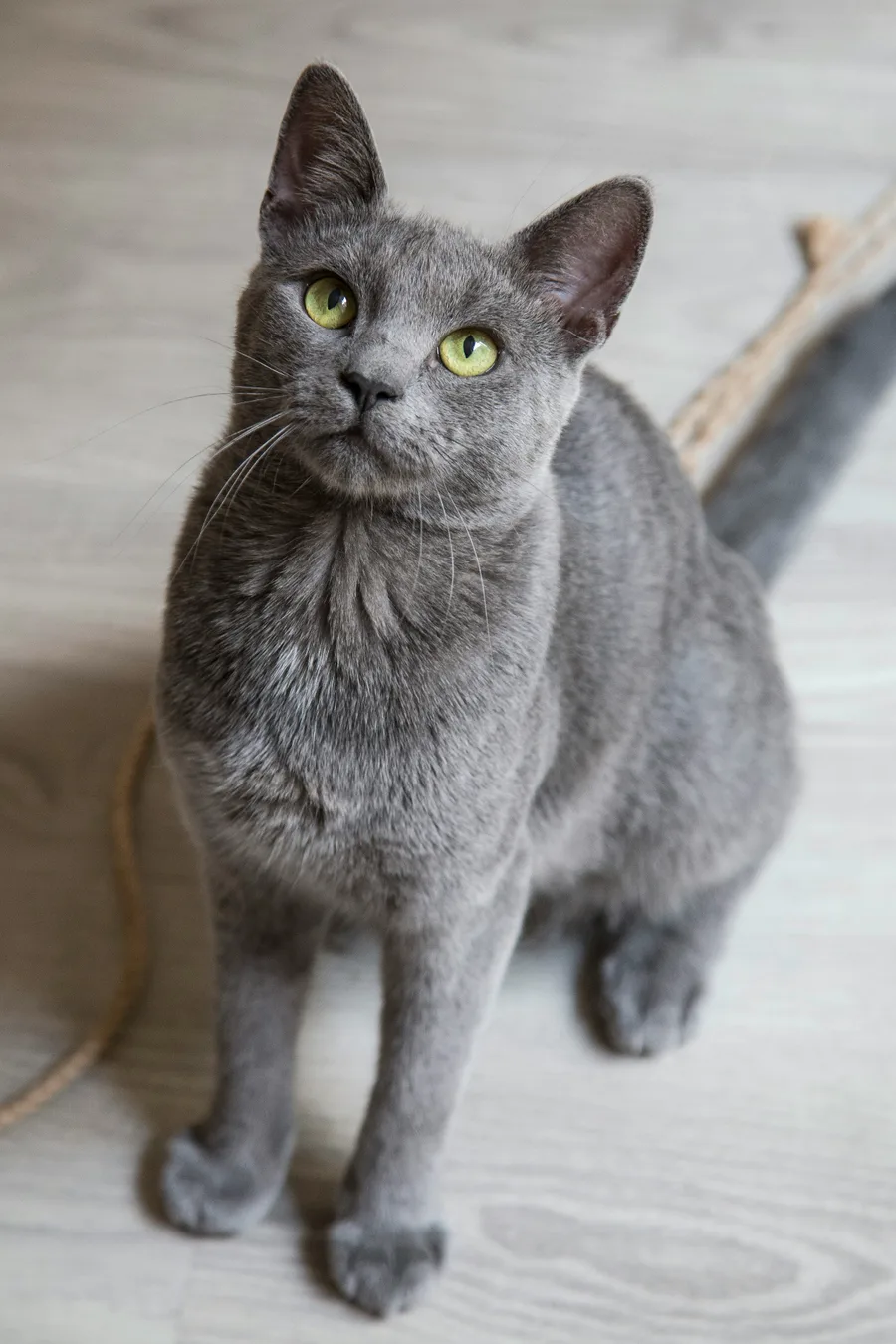
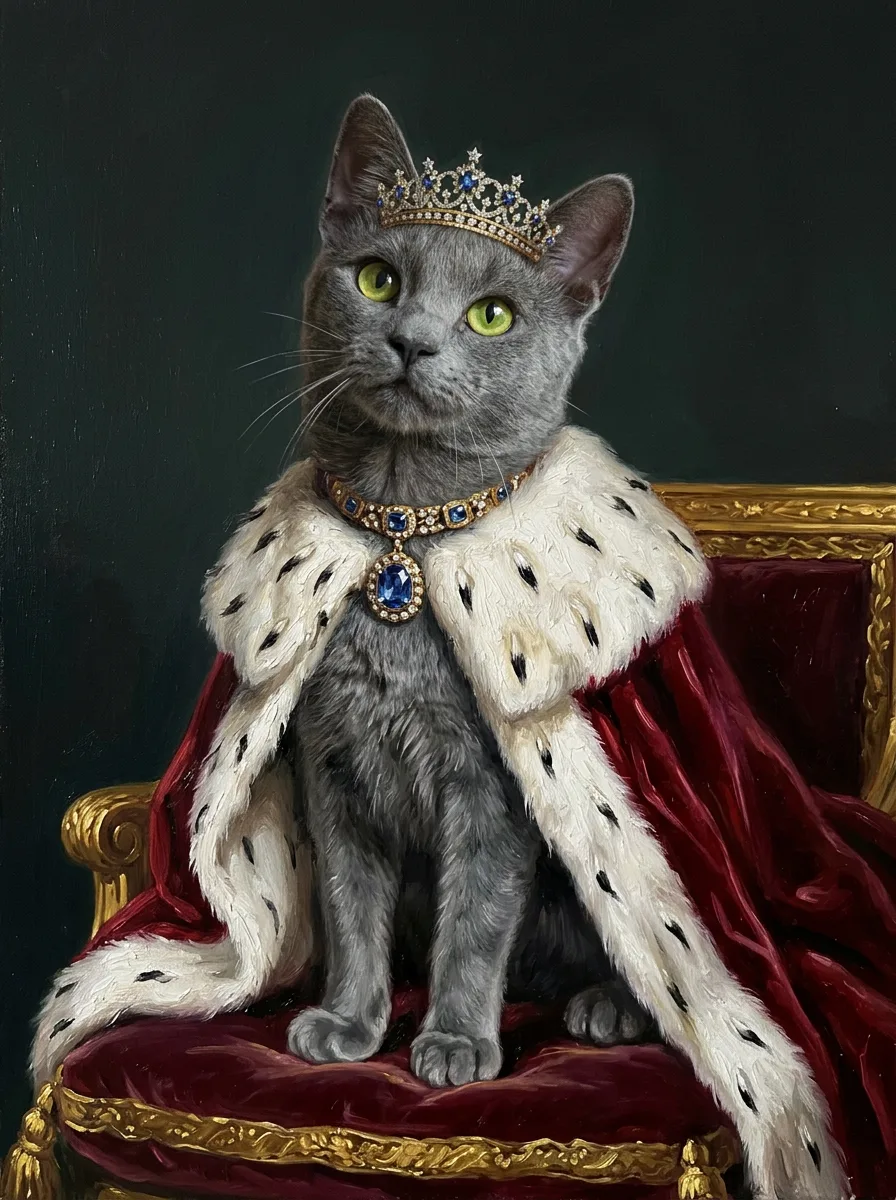
A funny pet portrait works on contrast: a solemn Old Master composition, full ceremonial seriousness, wrapped around a dog who is, by any objective measure, an idiot. British buyers tend to get this instinctively — the humour lands harder with understatement than with props or slapstick. Fur d'Amore builds these portraits from your own photograph, in any of six styles, so the joke is specific to your particular pet rather than a generic gag.
Why the Joke Works: Solemnity Meets Sock-Eating
Comedy needs two things in tension. A funny pet portrait supplies both: the visual grammar of a formal, centuries-old portrait tradition, and a subject who has never sat still for anything in its life. The joke isn't the pet — most pets are simply pets, doing pet things. The joke is the mismatch between the gravity of the composition and the mundane, faintly ridiculous reality of the animal wearing it. A Border Collie rendered with the full solemnity of a Baroque portrait is funny precisely because nothing about a Border Collie's actual daily behaviour — barking at the postman, herding the children, eating something it shouldn't — deserves that treatment. The portrait insists otherwise, with a completely straight face, and that insistence is the entire joke.
This is why the humour survives repeated viewing in a way a purely comic image often doesn't. A photograph of a dog in a novelty costume is funny once. A formally composed portrait that treats an inherently undignified animal with total seriousness keeps working every time someone walks past it in the hallway, because the joke isn't a reveal — it's a tension, and the tension is built into the artwork rather than dependent on a punchline landing twice.
The same logic explains why an ordinary funny photo of a pet doesn't need a formal treatment at all, and why a formal treatment of a genuinely elegant pet often isn't funny. The gap has to exist on both sides — the seriousness of the style has to be real, and the animal's daily behaviour has to be recognisably, specifically undignified. A greyhound already looks vaguely aristocratic at rest, so a Royal portrait of a greyhound reads as flattering rather than comic. A Labrador who has just eaten something inadvisable off the pavement reads entirely differently, and that's the difference worth photographing for.
The British Sense of Humour: Understatement, Not Slapstick
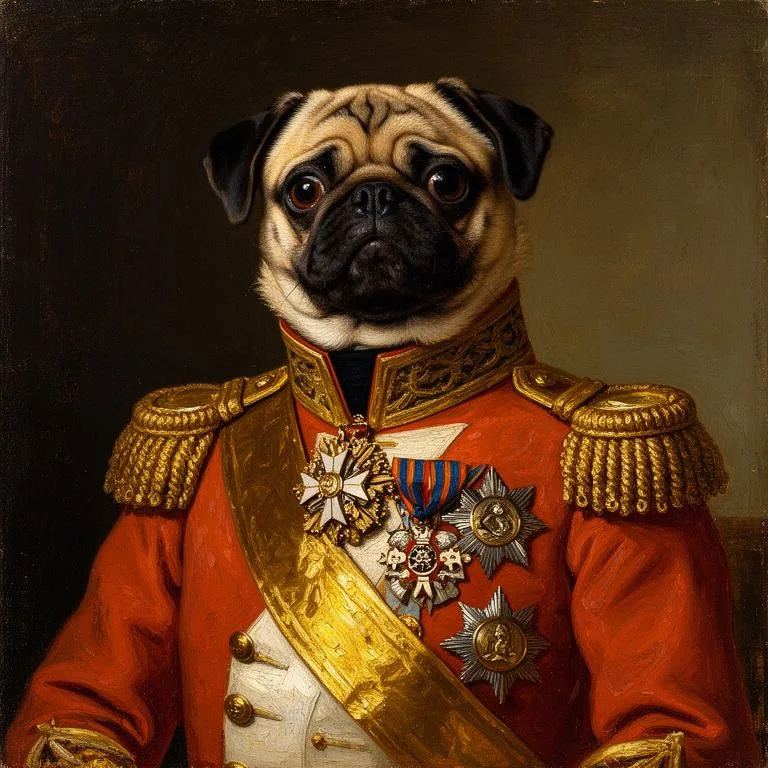
There's a version of this idea that goes broad — a dog in an oversized novelty hat, a cat wedged into a costume, arrows and captions doing the joke's work for it. That version has its place, but it's closer to a birthday-card gag than to the kind of composed, deadpan seriousness Renaissance and Baroque portraiture actually specialised in. The funnier version, in the register Fur d'Amore works in, plays it straight. No visible wink. No caption explaining the joke. Just a Cockapoo rendered with the ceremonial gravity of a Military portrait, medals and all, offering no acknowledgement that anything about the situation is unusual.
Understatement does more work than exaggeration here. The portrait itself never breaks character — it's the viewer who has to notice the gap between the composition and the animal, and that small delay, that moment of realising what you're actually looking at, is where the laugh happens.
How to Choose a Funny Photo
Not every photo makes a funny portrait, and the funniest photos are rarely the most flattering ones. Look for whatever your pet does that you'd never choose for a formal photograph: the mid-yawn with every tooth on display, the one ear inside-out, the expression of faint disdain a cat produces roughly forty times a day, the tongue caught mid-loll. These details, run through a formal style, are exactly what makes the contrast work — a picture-perfect, camera-ready pose tends to produce something merely handsome rather than funny. If you're not sure what counts as a flattering photo versus a funny one, the RSPCA's dog advice and cat advice both cover normal expressions and body language, which is a useful check before deciding a particular look is portrait-worthy rather than a sign something's wrong.
Lighting and clarity still matter. The joke depends on the formal treatment reading clearly, which means the underlying photo still needs to be reasonably well lit and in focus — a blurry photo just looks like a bad photo, however good the expression underneath it.
It's worth uploading two or three candidate photos rather than committing to the first one that makes you laugh on your phone. An expression that's funny for half a second on a small screen doesn't always survive being rendered at full size on canvas, and the free preview is the cheapest way to find out before anything gets printed.
Which Styles Are Funniest for Which Pet?
Britain's most recognisable breeds, as catalogued by the Royal Kennel Club, each carry their own comic potential depending on the style — a fact Dogs Trust's breed guides bear out, if rather more earnestly, and Cats Protection's equivalent guidance for cats does much the same. Some pairings of style and animal earn a bigger laugh than others. The table below is a starting point, not a rule, and you can browse all six styles before deciding.
| Style | Comic effect | Best suited to |
|---|---|---|
| Military | Solemn discipline meets total domestic chaos | Boisterous, badly behaved dogs — Labradors, Border Collies |
| Baroque | Theatrical drama layered over a squashed, unimpressed face | French Bulldogs and other flat-faced breeds |
| Aristocrat | Snooty refinement undercut by a lolling tongue | Jack Russells, Cockapoos, anything perpetually pleased with itself |
| Renaissance | Old Master calm layered over a chaotic personality | Cats mid-loaf, unbothered British Shorthairs |
| Royal | Absolute ceremony for the least ceremonious pet | Small, scrappy dogs and cats punching above their weight |
Where the Joke Tips Into Naff
There's a point where a funny portrait stops being funny and starts being try-hard, and it's worth knowing where that line sits before you order one. Piling on extra props, exaggerated captions or a style chosen purely for shock value tends to undercut the joke rather than sharpen it — the humour depends on the formal treatment being played completely straight, and anything that visibly winks at the viewer breaks that. The safer approach: choose the style for how well it suits your pet's actual personality, not for how absurd the combination sounds in your head. A well-observed mismatch is funnier than an engineered one.
A useful test: imagine the portrait hanging in the hallway in six months, once the immediate joke has worn off. A portrait built around a genuine, recognisable detail of your pet's character tends to keep earning a smile from visitors. A portrait built purely around an exaggerated gimmick tends to look like exactly what it is — a gimmick, and a slightly tired one at that.
Is It Actually Painted, or Is This AI?
Yes — it's AI. The artwork is AI-powered, which is what makes the free preview possible before you pay for anything; you see whether the joke lands before committing. The craftsmanship after that point is entirely physical: archival canvas printing and a heritage frame, the kind of object built to survive being handled and hung rather than only ever viewed on a screen. Some commissioned-painting studios offer a slower, more traditional process at a correspondingly higher price and longer wait; Fur d'Amore's approach is a different one, not a disguised version of that.
When to Give a Funny Pet Portrait in the UK
A funny pet portrait suits occasions that don't call for solemnity — a birthday, a Christmas stocking filler that turns out to be considerably better than a stocking filler, or genuinely no occasion at all. Father's Day, in June, is a reliable one too: a portrait that treats the family dog with more ceremony than anyone in the house actually shows him tends to land well, and there's more inspiration on the gifts for dog lovers and gifts for cat lovers pages. It also works as an office leaving gift or a housewarming present for someone who has just acquired a new pet and needs reminding what they've signed up for — the PDSA's new-owner advice covers the practical side of that adjustment. For gifts with a broader personalised angle, see personalised pet gifts too.
What Does It Cost, and How Does Delivery to the UK Work?
Funny portraits sit on the same price ladder as Fur d'Amore's more solemn styles: from around £15 for a digital download to about £226 for the largest heirloom-framed canvas, with desk portraits and unframed canvas sizes in between. Prices move with exchange rates, so the figure at checkout is the one that applies. Fur d'Amore is rated 4.9/5 by 10,000+ customers, which at least suggests the joke lands often enough to be worth the price of finding out.
Fur d'Amore ships to the United Kingdom, with prices shown in pounds and shipping calculated at checkout before you pay. Digital downloads are available instantly; printed and framed portraits take 5–7 business days for production, and international delivery typically takes 7–14 business days, as stated in the questions section of the Fur d'Amore homepage. Parcels sent from outside the UK can attract import VAT and, above certain thresholds, customs duty; HMRC's guidance explains the general rules.
Sources and further reading
Frequently asked questions
Why are funny pet portraits funny?
The humour comes from contrast: a solemn, centuries-old portrait style applied with total seriousness to a pet doing something entirely undignified. The formal treatment never winks or explains the joke — the viewer has to notice the gap between the composition and the animal, and that moment of recognition is where the laugh happens.
Which style is funniest for a dog versus a cat?
It depends on personality more than species. Military and Baroque tend to suit boisterous, expressive dogs, playing discipline or drama against real chaos. Renaissance and Royal often work best for cats, since their natural stillness makes the contrast between grand composition and everyday indifference land harder.
Is a funny pet portrait actually painted, or is it AI?
It's AI. The artwork itself is AI-powered, which is what makes a free preview possible before you pay. The physical parts — archival canvas printing and the heritage frame — are not automated; they're the craftsmanship that makes the finished piece something worth actually hanging up.
Does Fur d'Amore deliver funny pet portraits to the UK?
Yes. Fur d'Amore ships to the United Kingdom, prices display in pounds, and shipping is calculated at checkout before you pay. Parcels sent from outside the UK can attract import VAT and, above certain thresholds, customs duty, under HMRC's general rules for goods arriving from abroad.
What's a good UK occasion for a funny pet portrait?
Birthdays, Christmas stockings and Father's Day in June all work well, alongside no occasion at all. Prices run from around £15 for a digital download to about £226 for the largest heirloom-framed canvas, with sizes in between; the exact figure shown at checkout is the one that applies.