Personalized Gifts for Him: What Each Type Signals
There are four ways to personalize a gift for a man — monogram, engraving, photograph and portrait — and they signal four completely different things, which is why buying the wrong one lands badly even when the object is good. A monogram says this belongs to you. An engraving says this happened between us. A photograph says look at this. A portrait says this matters enough to hang on a wall. Most bad personalized gifts are not badly made. They are the right sentiment delivered by the wrong method, on the wrong surface, at the wrong volume.
What counts as a personalized gift?
Anything modified to refer to one specific person. That is a wide net, and it hides an important distinction: some personalization adds information about him, and some only adds a label. Three initials on a wallet is a label. A photograph of his dog is information. The difference decides how the gift is received, because a label can be applied by a machine to a stranger, and information cannot.
Rank the four methods by information content and the order is fixed: monogram lowest, engraving next, photograph next, portrait highest. Rank them by status — how seriously the finished object presents itself — and the order scrambles, because a photograph printed on a mug carries maximum information and minimum dignity. The trick is to choose a method that scores on both.
| Method | What it signals | Belongs on | Fails when |
|---|---|---|---|
| Monogram | This is yours. Ownership, membership, a class code | Carried leather, luggage, shirt cuffs | Applied to something he does not carry, or the letter order is wrong |
| Engraving | This happened between us. Private, permanent, usually hidden | Watch case backs, ring interiors, knife bolsters, pens | The text runs past six words, or the sentiment is generic |
| Photo printing | Look at this. Maximum information, minimum ceremony | Paper, canvas, anything that goes behind glass | Applied to mugs, cases, socks, blankets, anything washable |
| Portrait | This matters. Full image, plus the authority of a frame | A wall, at eye level, in a room people enter | The source photograph is blurred or the faces are in shadow |
| Made-to-measure | I know your dimensions. High utility, no sentiment at all | Shirts, jackets, boots, anything worn | You guessed the measurements |
What does a monogram actually signal?
Ownership, and a quiet claim to a certain kind of world. Monograms come out of a tradition of marking property: silver, linen, luggage, all stamped so it could be sorted after a journey or a laundry. The Metropolitan Museum of Art and the Rijksmuseum are both full of domestic silver bearing a household’s marks for exactly that reason.
So a monogram works on objects he carries and other people see: a card holder, a weekender bag, a passport cover, cuffs. It works badly on anything static in his own house, because there is nobody to sort it from. Two warnings. First, three letters is the ceiling; a full name printed out reads as school uniform. Second, two conventions for letter order are in circulation — straight reading order, and the version that enlarges the surname in the centre — and they are not interchangeable. Pick one, confirm it with the seller, and check the proof before the machine runs.
When is engraving the right choice?
When you have something specific to say and want it to be permanent and mostly invisible. Engraving is the intimate method: a date on a watch case back, a set of coordinates inside a band, four words on the flat of a pocket knife. He is the only person who ever sees it, which is the entire point. A gift that performs for an audience is a different gift.
The failure mode is volume. Engraving space is small and the temptation is to fill it. Six words is the limit and four is better. "22.09.14" outperforms a sentence about how proud you are, because a date makes him do the remembering himself and a sentence does it for him. Choose an object he already uses daily — a watch, a knife, a pen — and the engraving inherits that object’s life.
Do photo gifts work for men?
The image is never the problem. The substrate is. The same photograph of his dog looks disposable on a ceramic mug and permanent behind glass in a dark frame, and the object he keeps for twenty years is the second one. Photo printing on washable goods fails because the printing degrades, and because the object was already cheap before you customised it.
Photo gifts that work: one image printed large and framed, a hardback book of pictures from a single year, an old damaged photograph scanned and repaired. Photo gifts that do not: mugs, phone cases, socks, mouse mats, blankets, jigsaw puzzles. If a thing goes in a dishwasher it should not have his father’s face on it. For how a single photograph becomes something worth framing, see custom family portrait.
When does a portrait beat everything else?
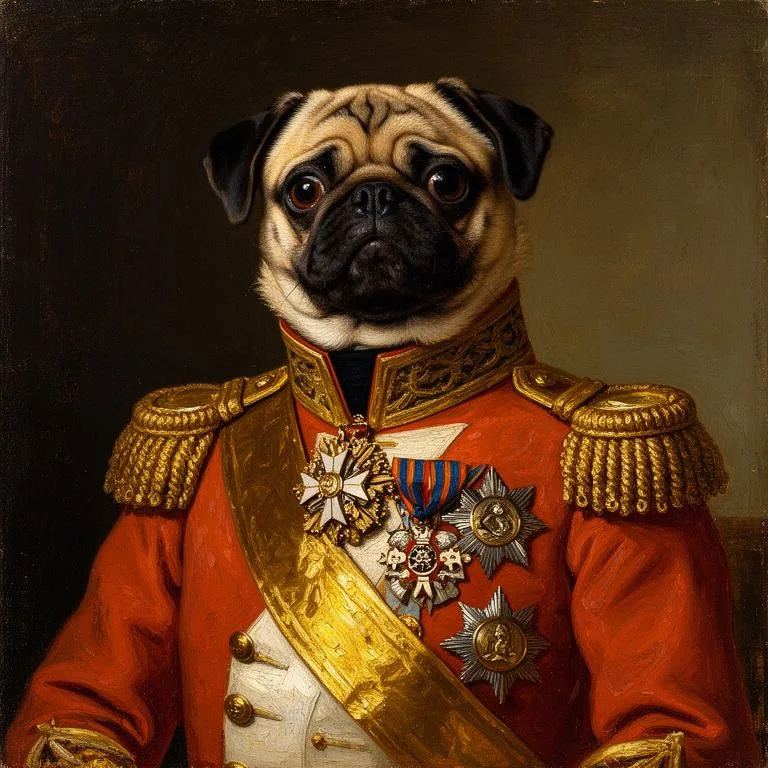
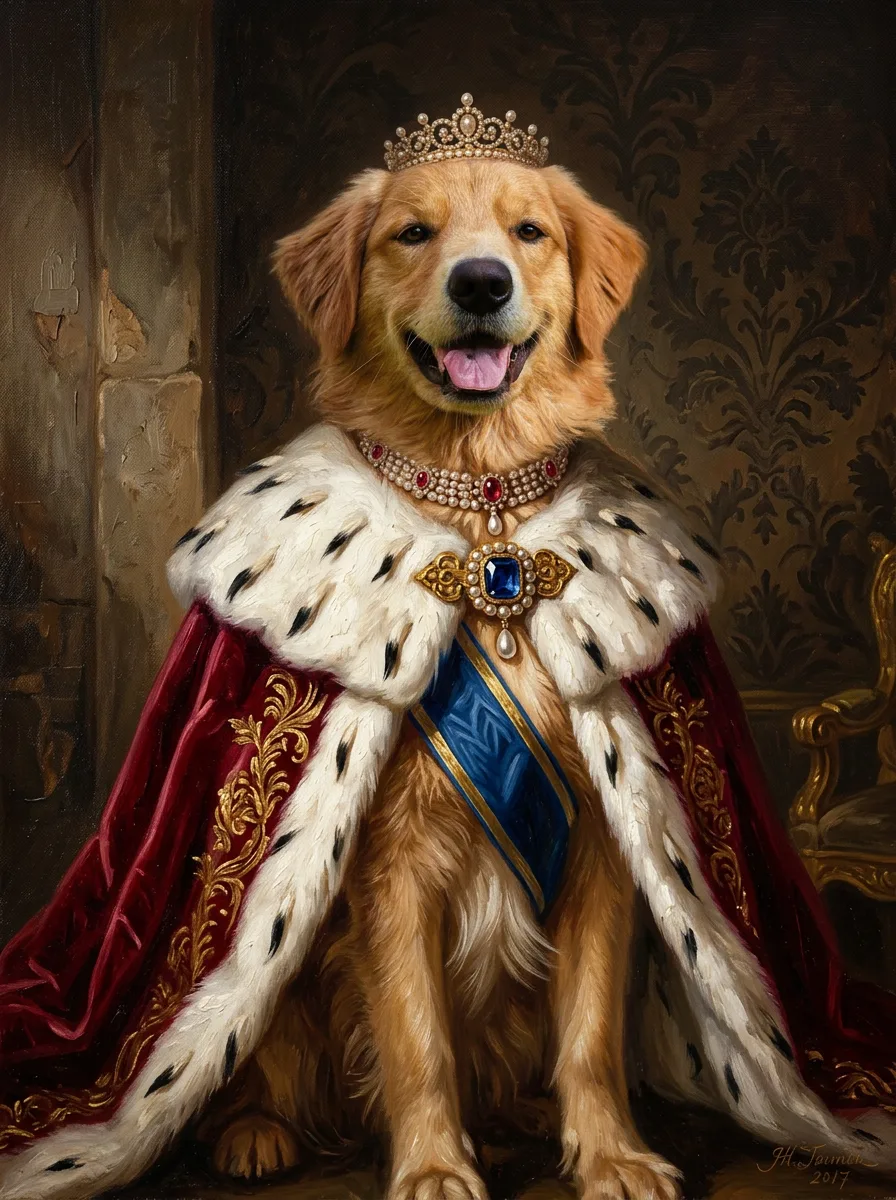
When you want the gift to be seen by other people, hold its value over decades, and carry more than a label. A portrait is the only method on this list that combines full image information with the social weight of a framed object on a wall. That combination is old and it still works: the Smithsonian National Portrait Gallery and the National Gallery of Art are built on the premise that a likeness in a frame is a statement, not a decoration. The history of the genre is essentially the history of people paying to be taken seriously.
Fur d’Amore builds the artwork with AI from a photograph already on your phone, then prints it on archival canvas and sets it in a heritage frame. Six styles are available — Royal, Aristocrat, Renaissance, Baroque, Military and Romantic — and for men the Military and Aristocrat treatments do the most work, because the comedy of the braid sits against a face everyone at the table knows. Send a JPG or PNG up to 10MB, see a free preview before paying, and if he and the dog were never photographed together, they can be composed from separate images. The dog portrait from photo page shows how that works, and custom pet portraits from photos covers the process end to end.
What makes personalization go wrong?
- Too many words. A surface the size of a postage stamp is not a greetings card.
- Praise directed at him. "Best dad in the world" is a claim he now has to display. Facts age better than compliments.
- Wrong initials, wrong order, wrong spelling. Personalized goods are almost never returnable, which is worth remembering before you approve a proof.
- Personalizing a bad object. Customization multiplies whatever the object already was. A cheap thing with his name on it is a cheap thing he cannot give away.
- A blurred source photograph. Sharp faces, even light, taken at eye level. Everything downstream depends on this.
One more, and it is the one nobody mentions: personalization removes his exit. He can quietly rehome a plain sweater. He cannot rehome a sweater with his initials on it, so he keeps it in a drawer for nine years and feels vaguely guilty. Personalize things you are confident about.
How much should personalization cost?
Monogramming and engraving typically add $10 to $40 to the price of the object, which makes them the cheapest upgrade in gifting and the most frequently skipped. For artwork the market bands are steady: roughly $30 to $60 for a digital file, $90 to $150 for a gallery-wrapped canvas, and $150 to $250 and up for a framed piece, rising with size and the number of subjects. Commissioned oil painting sits far above that and is priced per sitting.
Two things are worth checking before paying. Ask what the print is actually made of; the term giclée means pigment inks on archival stock when used properly and nothing at all when used loosely. And read the returns terms, because customized goods are usually exempt from them — the FTC’s consumer advice is a fair sanity check on an unfamiliar seller. On longevity, the Getty makes the point that applies in any house: keep it out of direct sun and it looks the same in twenty years.
If none of the four methods fits, the honest fallback is a donation in his name to something he already funds — Charity Navigator makes it quick to check the organisation is worth the money. For more angles see dog dad gifts, personalized pet gifts, gifts for grandparents, and the same argument run for a wedding in personalized wedding gifts.
Sources and further reading
Frequently asked questions
What is the best personalized gift for him?
A framed portrait of him with his dog, because it is the only method that carries a full image rather than a few letters and still reads as a serious object. Below that, an engraved date on something he already wears, and a monogram on a piece of leather he carries daily.
Is a monogram or an engraving better?
They do different jobs. A monogram marks ownership and is meant to be seen, so it belongs on carried leather and luggage. An engraving carries meaning and is usually hidden, so it belongs on a watch case back or the inside of a band. If you want the gift to say something specific, engrave it.
Do photo gifts work for men?
On paper, canvas and in frames, yes. Printed onto mugs, phone cases, socks and blankets, no. The image is not the problem; the substrate is. The same photograph that looks cheap on ceramic looks permanent behind glass, and men keep the second one for decades.
How much do personalized gifts for him cost?
Monogramming and engraving usually add 10 to 40 dollars to whatever the object costs. For artwork the market runs about 30 to 60 dollars for a digital file, 90 to 150 for a gallery canvas, and 150 to 250 and up for a framed piece. Personalization is rarely the expensive part.
What personalized gifts should you avoid?
Anything with his full name spelled out, slogans about how great he is, long quotes crammed onto a small surface, and photo printing on objects that go through a dishwasher. Also avoid personalizing something he did not want unpersonalized, because customization removes his right to return it.
Written by the Fur d’Amore studio — we reimagine the people and pets you love as Renaissance masterpieces on museum-grade canvas. See the portraits or browse all six portrait styles.