Funny Pet Portraits: How to Get One That Works
A funny pet portrait works when nothing in it is trying to be funny. The comedy comes from the gap between a serious painterly format — medals, ermine, oil-painting shadow — and a beagle wearing it with complete conviction. Add a joke caption or a cartoon effect and the gap closes, the laugh gets shorter, and the piece ends up in a drawer. Below: which styles are actually funny, which photo to send, and how to tell a portrait that will still land in five years from one that peaks on the group chat.
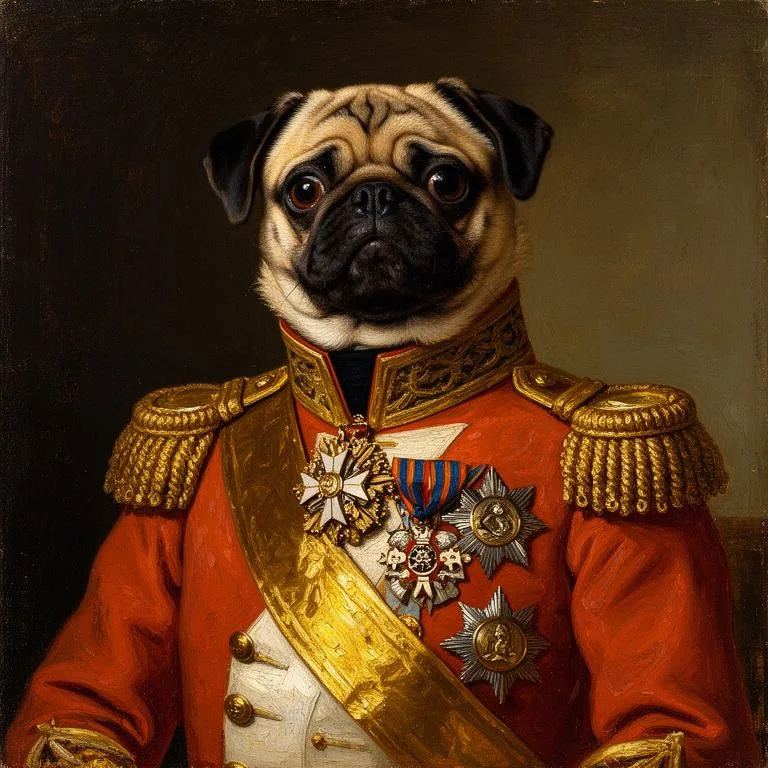
Why does a straight-faced portrait get more laughs than a joke one?
Because the humour is structural rather than decorative. Portraiture is a genre built to communicate status, character and permanence — it emerged as an independent form precisely because people wanted their importance recorded. Every visual convention in a Renaissance portrait, from the three-quarter turn to the fur trim, is a signal that says this person matters. Apply that entire apparatus to a spaniel and the signal misfires beautifully. The dog is not in on it. That is what makes it funny.
Decorative jokes work in the opposite direction. A cartoon speech bubble tells you where to laugh, which means you only laugh once. A straight portrait keeps producing the effect every time someone new walks into the room and takes a second to register what they are looking at.
This is also, incidentally, very old comedy. Animals in Western art have been standing in for human vanity for a thousand years — the Met's survey of animals in medieval art is full of apes performing human tasks and beasts appearing on family coats of arms as heraldic puns. And if you want to see how seriously the format takes itself, the National Gallery's Renaissance masterpieces tour is a short course in the visual language a good funny pet portrait is quoting.
Nine funny pet portrait concepts that actually work
- The decorated general — medals, sash, unearned authority
- The monarch — ermine, crown, total composure
- The minor aristocrat — ruff collar, faint disdain
- The Baroque dramatist — heavy shadow, theatrical light
- The romantic lead — soft focus, wistful middle distance
- The scholar — robes, books, an air of unearned expertise
- The dynastic family group — every pet, arranged by rank
- The matched pair — two animals, one clearly in charge
- The human-and-pet double portrait — owner visibly outranked
The last three are underused and reliably the funniest, because group compositions invite hierarchy. Two cats painted as co-monarchs is a better joke than either cat alone.
Which style suits which animal?
Style choice does most of the comic work, and it should follow the animal's existing personality rather than fight it. A dog that already looks self-important becomes hilarious in uniform; a genuinely sweet-faced dog is funnier as a romantic lead, because the sincerity is the joke.
| Style | Best for | Comic register |
|---|---|---|
| Military | Stocky, serious-faced dogs; anything that patrols the garden | Broadest laugh — medals are the most obviously unearned |
| Royal | Any animal with visible entitlement; large fluffy cats | High — ermine plus indifference is a reliable formula |
| Aristocrat | Aloof cats, elegant sighthounds | Dry — the disdain does the work |
| Baroque | Big dramatic dogs; dark coats that hold shadow | Theatrical rather than funny — impressive first, amusing second |
| Renaissance | Almost anything; the most versatile of the six | Gentle — reads as tribute more than gag |
| Romantic | Soft-faced dogs, young animals, pairs | Warm — the least funny and often the best gift |
Two of those — Renaissance and Romantic — are not really jokes at all, and that is worth knowing before you order. If the portrait is for someone else, the tender styles usually age better than the loud ones. If it is for your own hallway and you want people to stop and laugh, go Military or Royal. You can see all six side by side on the portrait styles hub, or read up on the military pet portrait specifically.
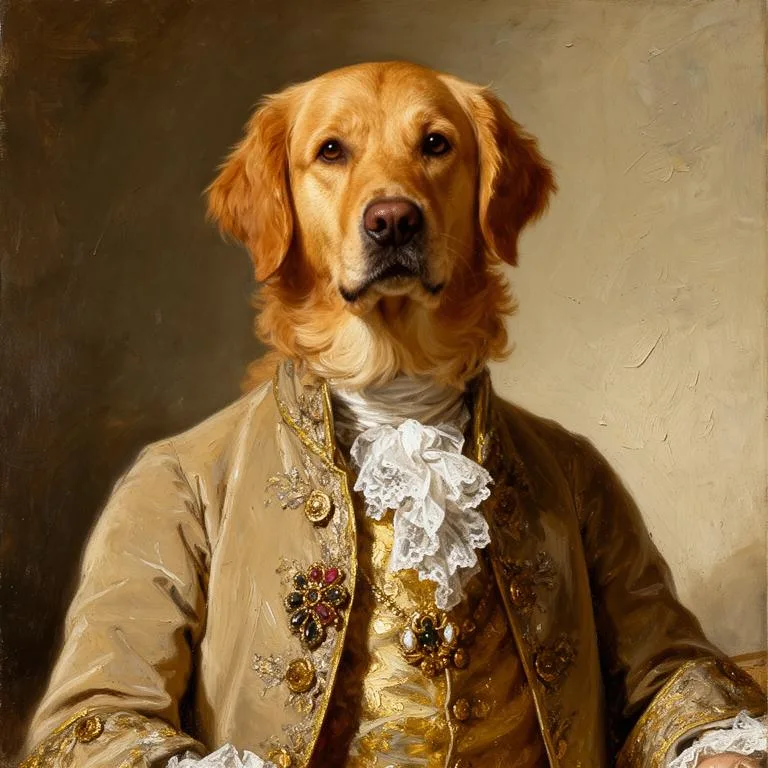
What photo should you send?
Here is where most funny portraits go wrong. People submit the funniest photo they own — the mid-yawn shot, the tongue-out blur, the one taken from directly above — and are then disappointed that the result looks chaotic rather than noble.
Send the dignified photo instead. The costume supplies the comedy; the face needs to supply the conviction. Practically:
- Front-facing or a slight three-quarter turn. This is the angle Renaissance portraiture actually uses, so it composites naturally.
- Eyes sharp and visible. Everything else is forgivable. Blurred or hidden eyes are not.
- Daylight, not flash. Window light or an overcast day. Direct flash flattens the face and blows out pale fur.
- Neutral expression beats an extreme one. A calm animal in a general's uniform is funnier than an excited one.
- Fill the frame with the head. Close, but not so close that a wide phone lens distorts the snout.
If your best image is an old print rather than a digital file, handle it by the edges and photograph or scan it in even, indirect light — the Library of Congress guidance on the care, handling and storage of photographs is the standard reference for anything irreplaceable. For a fuller walkthrough of photo selection, see our guide to custom pet portraits from photos.
How do you avoid a gimmicky result?
Four rules, in rough order of importance.
One idea per portrait. A cat as a monarch is funny. A cat as a monarch riding a motorcycle in space is noise. The joke needs a stable format to push against.
No captions. Text on the artwork converts a portrait into a poster and caps its lifespan at about a fortnight.
Respect the animal's proportions. Exaggerated features look like a caricature rather than a painting, and caricature ages badly on a wall. The likeness has to be accurate for the joke to be affectionate rather than mocking.
Judge the object, not just the image. This is the one most people skip. A good concept printed on thin canvas in a flimsy frame is still a bad gift. Ask what the print process is — giclée describes fine-art inkjet printing on archival substrates, usually with pigment-based inks that resist fading far better than dye-based ones. Ask what the frame is doing: UV-opaque glazing and acid-free board are what stop a print yellowing on a sunny wall, and the Library of Congress preservation guidelines for matting and framing spell out exactly what to request.
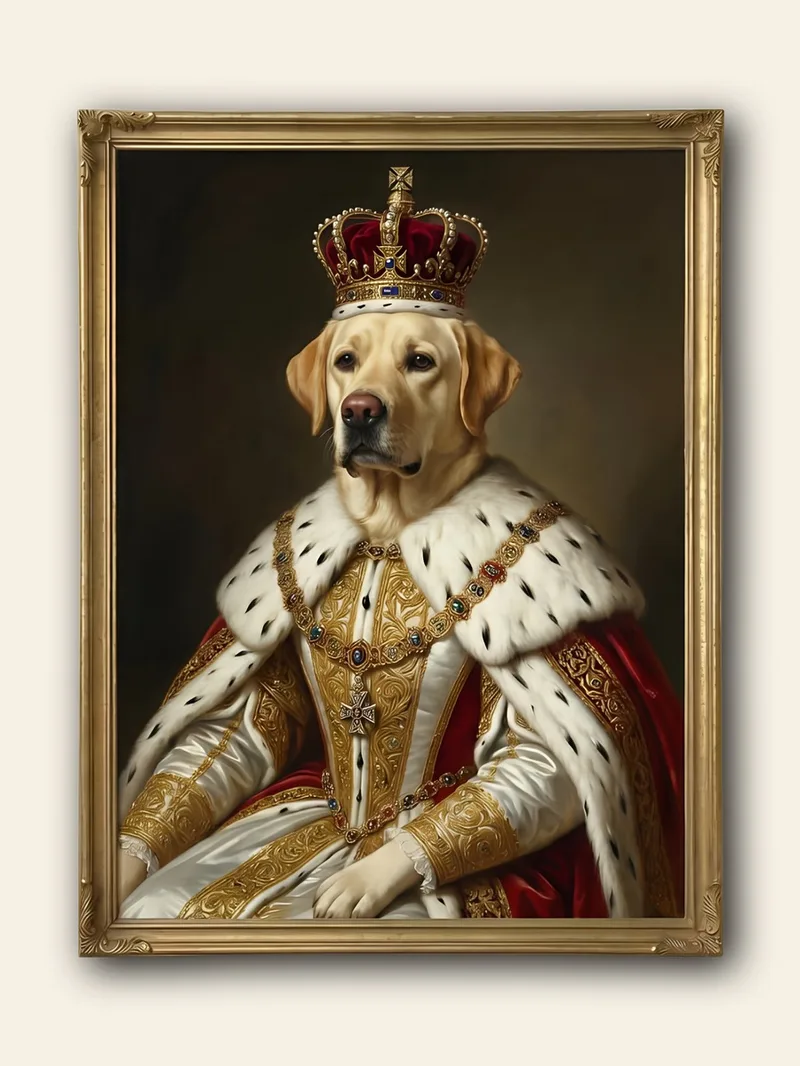
Is a funny pet portrait a good gift?
It is one of the few gifts that works on two timescales. On the day, it gets a genuine laugh — the recipient looks at their own animal wearing a general's sash and reacts before they can think about it. Six months later it has quietly become sentimental, because it is still the only picture of that animal in the house that anyone framed.
Two cautions. First, know the recipient's taste: a maximalist Baroque piece in a minimalist flat will not get hung, and an unhung portrait is a failed gift. Second, and more important, check the circumstances. If the animal has recently died, this is the wrong category entirely — no costumes, no jokes, no urgency. Our guides to pet memorial gifts and pet memorial ideas cover that register properly.
On the practical side, buy the way you would buy any custom item: confirm you can see a preview before paying, read the return terms first, and keep records. The FTC's online shopping guidance is the plain-English version of all of that.
Are these portraits AI-generated?
Ours are, and we say so plainly. Fur d’Amore uses AI-powered artistry to build the portrait from your photograph; the craftsmanship sits in the physical object — archival canvas, giclée printing, a heritage frame. The practical consequence for a funny portrait is a good one: you can see a free preview, try a different style if the first joke does not land, and only pay once you are looking at something you actually want on a wall.
Everything else about pet ownership is unaffected by any of this, but while you are here: the American Kennel Club, the Cornell Feline Health Center and Humane World for Animals are the three most useful general references for dog and cat owners, and the ASPCA plant toxicity database is worth bookmarking before you next buy flowers for a household with a cat in it.
Sources and further reading
Frequently asked questions
What makes a funny pet portrait actually funny?
The contrast between a serious painterly format and an animal wearing it with total conviction. The comedy is structural, not decorative. Portraits that add cartoon effects, joke captions or exaggerated expressions usually get a single laugh and then stop working, while a straight-faced Old Master treatment keeps landing for years.
Which style makes the funniest pet portrait?
Military and Royal are the strongest comic styles, because medals and ermine are the most obviously unearned. Aristocrat suits a haughty cat. Baroque works well for a large, dramatic dog. Romantic and Renaissance read as more tender than funny, which is often the better choice for a gift.
What photo should you use for a funny pet portrait?
A clear, well-lit, front-facing photo where the eyes are sharp and the whole face is visible. Resist the temptation to submit the funniest photo you own — a mid-yawn action shot rarely converts well. A neutral, dignified expression is what makes the costume funny by contrast.
Is a funny pet portrait a good gift?
It is one of the strongest gifts in the category, because it works on two levels: it gets a laugh on first sight and becomes genuinely sentimental afterwards. Judge the physical object as carefully as the concept — a good joke printed badly is still a bad gift.
Can you put more than one pet in a funny portrait?
Yes, and group compositions are often funnier than single portraits because the format invites hierarchy. A dynastic family group, with one animal seated and the others arranged around it, produces more comedy than the same pets rendered as separate pieces on the same wall.
Written by the Fur d’Amore studio — we reimagine beloved pets as Renaissance masterpieces on museum-grade canvas. See the portraits, browse more pet portrait ideas, or read how Renaissance pet portraits are made.