What Makes a Pet Portrait Royal?
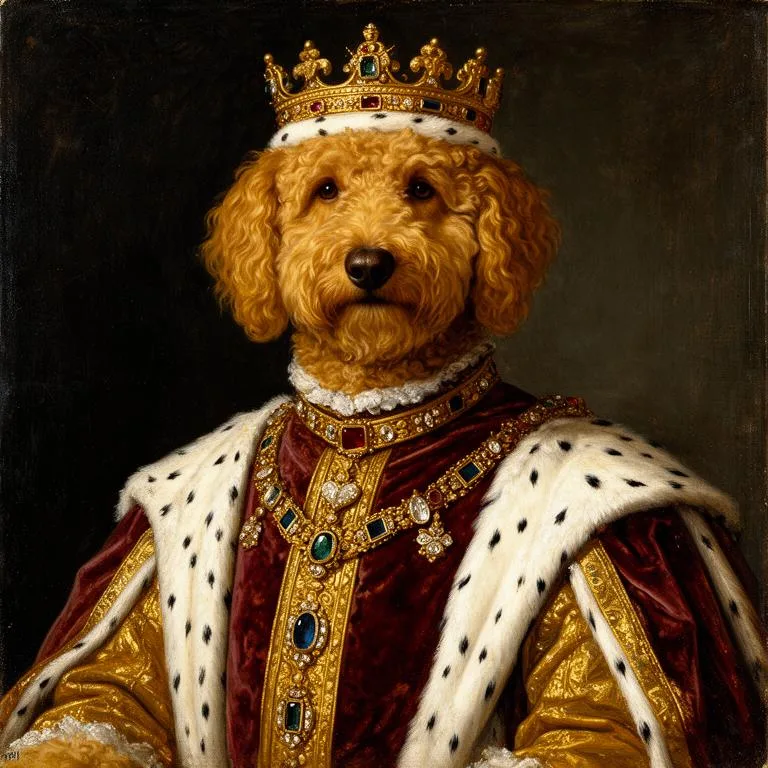
A royal pet portrait borrows its grammar from state portraiture — the pose, the drapery, the level gaze, the gilt frame — and applies it, without irony, to your dog or cat. Britain has more of that grammar hanging on its walls than almost anywhere else, from the National Gallery to the Wallace Collection, which makes it the natural home for the style. Fur d'Amore's Royal portraits take that formal language and apply it to a photograph you supply, printed on archival canvas.
What Is a Royal Pet Portrait?
A Royal portrait renders your pet's photograph in the visual language of a state portrait: ermine-trimmed robes or a formal collar, velvet or brocade drapery, occasionally a coronet, and a composure that suggests the sitter has done this before. It is not a costume photograph with a crown drawn on top. The pose, the lighting and the frame are considered together, in the way a court painter would have approached an actual monarch — except the sitter here is, more often than not, a beagle.
What separates a Royal portrait from a merely nice one is restraint. Nothing about it is trying too hard to be funny or too hard to be cute — it commits fully to the premise that the sitter is, for the duration of the portrait, of some consequence. That commitment is what makes the style work on a cat as readily as a dog: cats already believe themselves to be of some consequence, so a Royal portrait simply agrees with them.
The style sits within Fur d'Amore's six options, alongside Aristocrat, Renaissance, Baroque, Military and Romantic, but it is the most formal of the six and the one that leans hardest into ceremony. See the Royal style in full for examples across different breeds and coat colours.
Why Britain Is the Natural Home for the Royal Style
Other countries can attempt the Royal style. Britain has the reference material built into its walls. The National Gallery holds centuries of formal portraiture that established exactly what a state portrait is meant to communicate — authority, stillness, a gaze that meets the viewer without asking anything of them. The Wallace Collection goes further into the decorative grammar of the period: the drapery, the gilt, the sense that the frame is doing almost as much work as the canvas. Tate's own definition of portraiture makes the same point more plainly — a portrait is a record of a specific likeness, staged with intent.
Museums well beyond Britain hold plenty of state portraiture too — the Getty among them — but few countries pack quite as much of it into quite so many free public galleries. A beagle in ermine is a joke that only works because ermine has a genuine history of being taken extremely seriously, and Britain is where you go to see that history hanging at eye level.
The Anatomy of a Regal Portrait: Pose, Drapery, Gaze and Frame
This formal grammar has a long history in portrait painting, stretching back through Renaissance and Baroque traditions alike, long before anyone thought to apply it to a dog. Four elements do most of the work.
Pose. A Royal portrait favours a three-quarter turn or a direct, level gaze — the angle traditionally used to suggest the sitter is neither hiding nor performing. A dog looking slightly past the viewer reads as composed rather than obedient.
Drapery. Velvet, brocade or fur-trimmed fabric anchors the portrait in a specific period language. It does the same job it did in the eighteenth century: signalling that this is an occasion, not a snapshot.
Gaze. Steady and unhurried. A portrait where the subject looks alert or eager reads as a pet. A portrait where the subject looks entirely unbothered reads as royalty.
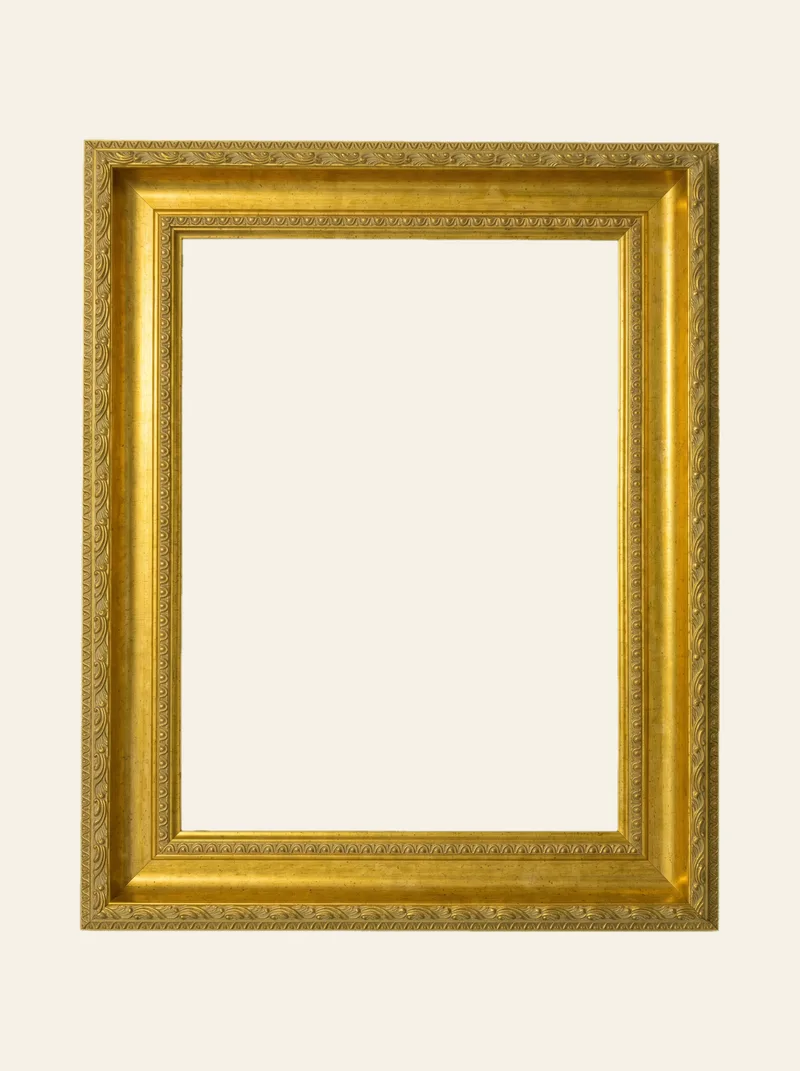
Frame. The heritage frame finishes the effect — a gilt or ornate edge that would look absurd around a phone-camera snapshot and entirely correct around a formal portrait. Fur d'Amore treats the frame as part of the artwork rather than packaging around it.
Royal vs Aristocrat vs Baroque vs Military: What's the Difference?
The six styles overlap in places, and Royal is most often confused with three of the others. The table below sets out what separates them.
| Style | Mood | Signature details | Suits |
|---|---|---|---|
| Royal | Solemn and ceremonial | Ermine, velvet, a coronet, a gilt frame | A pet with natural poise and a steady gaze |
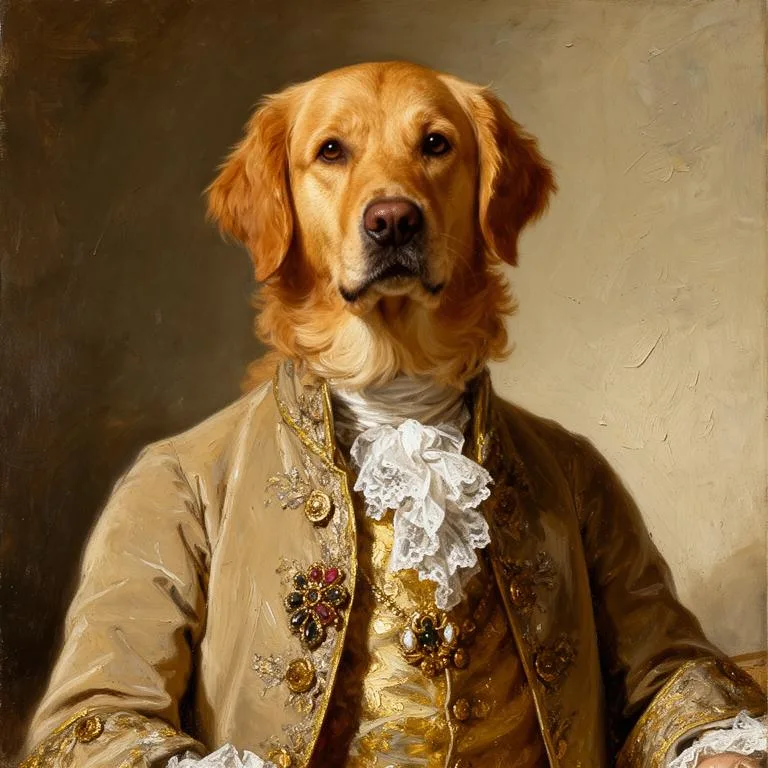
| Aristocrat | Refined and knowing | Cravats, pearls, tailored coats, a raised eyebrow | Characterful faces, dignified breeds |
| Baroque | Dramatic and theatrical | Deep shadow, gold light, swirling fabric | Bold markings, strong contrast |
| Military | Disciplined and proud | Braided uniform, medals, upright bearing | Sturdy, alert breeds |
For a closer look at each, see the Aristocrat, Baroque and Military style pages, or browse all six styles together.
Which Pets Suit the Royal Treatment?
Dignity is not a matter of size. Britain's most popular breeds, as tracked by the Royal Kennel Club, span the full range from unbothered to highly strung, and the Royal style has room for both. A Labrador Retriever carries it with obvious ease — the breed's steady, unbothered expression was practically made for a velvet collar. A British Shorthair or Ragdoll cat, with a naturally wide, calm face, tends to look as though it was born mid-portrait.
Smaller and more excitable breeds can work just as well, sometimes better, because the contrast is where the effect lands: a Jack Russell or Cockapoo rendered with full ceremonial seriousness is more charming than a naturally solemn breed treated the same way, precisely because nobody asked the Jack Russell to be dignified and it is trying anyway. A Cocker Spaniel's soft features suit the gentler end of Royal styling; a Border Collie's intense stare holds up well against the formality. French Bulldogs, with their famously direct expression, often look as though they were sitting for a state portrait long before anyone pointed a camera at them. Cats, on the whole, need less convincing than dogs — a Royal portrait simply confirms what most cats already suspected about themselves. Mixed-breed dogs and moggies take to the style just as well as any pedigree; the Royal treatment has never once checked a pet's papers.
Choosing the Right Photo for a Royal Portrait
A Royal portrait works best from a photograph taken at roughly eye level, in good natural light, with the face clearly visible and not obscured by toys, other pets or a bandana. A calm, forward-facing or three-quarter shot translates better than an action photo — the style depends on stillness, so a photo taken mid-run or mid-bark tends to fight against it rather than support it. Whatever the breed, the RSPCA's advice on keeping dogs relaxed and comfortable is worth a glance before any home photo session — a calm pet photographs better than a stressed one, portrait or otherwise.
You can upload more than one photo if you're not sure which will work best, or if you want to compare how the same pet looks across Royal and one of the other five styles before deciding. The free preview shows you the result before you pay for anything, so there is no cost to trying more than one image. If you have more than one pet and want them sharing a single Royal portrait, upload a clear photo of each — the composition can bring several animals into one scene, arranged with the same formality as a single sitter.
Framing a Royal Portrait for a British Home
A Royal portrait tends to suit a prominent spot — above the fireplace, at the top of the stairs on the landing, or along a hallway wall where guests will actually see it. The scale of the piece should match the scale of the ceremony: a small desk portrait in Royal style can look slightly at odds with itself, while a larger canvas gives the formality room to work.
The frame is not an afterthought. A gilt or ornate finish suits the Royal style's own logic — it is meant to look like the kind of object that has always hung exactly where you've put it. Fur d'Amore's heirloom framing comes in two heritage finishes, Medici Gold and Milanese Walnut. For a Royal portrait, Medici Gold tends to suit the ceremony most directly; Milanese Walnut offers a slightly more restrained alternative for a home that would rather not commit to quite so much gilt.
What Does It Cost, and How Does Delivery to the UK Work?
Royal portraits sit within the same range as Fur d'Amore's other five styles: from around £15 for a digital download to about £226 for the largest heirloom-framed canvas, with desk portraits and unframed canvas sizes in between. Prices move with exchange rates, and the figure that actually applies to your order is the one shown at checkout. Fur d'Amore is rated 4.9/5 by 10,000+ customers, for what that is worth to a portrait meant to look as though it doesn't need anyone's approval.
Fur d'Amore ships to the United Kingdom, with prices displayed in pounds and shipping worked out at checkout before you pay. Digital downloads are available instantly; printed and framed portraits take 5–7 business days for production, and international delivery typically takes 7–14 business days, as stated in the questions section of the Fur d'Amore homepage. Parcels arriving from outside the UK can attract import VAT and, above certain thresholds, customs duty; HMRC's guidance sets out the general rules.
Sources and further reading
Frequently asked questions
What is a royal pet portrait?
A royal pet portrait renders your dog or cat in the visual language of state portraiture — a formal pose, velvet or fur-trimmed drapery, a steady gaze and a gilt or ornate frame. Fur d'Amore builds it from a photograph you upload, in the Royal style, one of six available, printed on archival canvas.
How is the Royal style different from Aristocrat?
Royal is the more ceremonial of the two — ermine, coronets, a formal state-portrait pose. Aristocrat is refined rather than regal: cravats, pearls and tailored coats, with a knowing rather than solemn expression. Royal suits a pet with a naturally steady gaze; Aristocrat suits a more expressive, characterful face.
Does Fur d'Amore ship royal pet portraits to the UK?
Yes. Fur d'Amore ships to the United Kingdom, displays prices in pounds, and calculates shipping at checkout before you pay. Parcels arriving from outside the UK can attract import VAT and, above certain thresholds, customs duty, under HMRC's general rules for goods sent from abroad.
How much does a Royal-style pet portrait cost?
Prices sit on the same ladder as Fur d'Amore's other styles: from around £15 for a digital download to about £226 for the largest heirloom-framed canvas, with desk portraits and canvas-only sizes in between. Prices move with exchange rates, so checkout shows the figure that actually applies to your order.
Why is the Royal style particularly suited to Britain?
Britain has an unusually deep public collection of formal state portraiture, from the National Gallery to the Wallace Collection, which established the visual grammar the Royal style borrows — pose, drapery, gaze and frame. It gives British buyers a genuine point of reference most other markets simply don't have on their walls.